Heat Pumps in Massachusetts?
Cold winters and hot, humid summers in New England have always meant high heating costs in the winter and high air conditioning costs (or uncomfortable homes) in the summer. Massachusetts’ energy costs are among the highest in the country and continuing to rise. And because so much of our building stock is older, air conditioning in the summer often involves wrestling heavy AC units in and out of windows.
Homeowners often wait until an emergency before addressing this: their boiler fails and they replace it; summer hits and they buy another window AC.
A single air source heat pump system can replace both heating and air conditioning. In Greater Boston, the high energy costs mean that efficiency pays back faster here than almost anywhere. Older homes are exactly what heat pumps fit, because the technology is so adaptable and comes in a variety of formats. Central ducted systems can work with existing HVAC ductwork; ductless or mini-split systems don’t need ductwork and can be used to set up zoned heating or cooling; and newer, saddle-style heat pumps can be installed in existing windows.
This guide starts with how air source heat pumps work, then moves through whether they actually work in the New England winter, the different types of heat pumps, energy incentives and rebates that help pay for them, and why electrification is such a big deal for sustainability. Finally, it will cover how to decide if a heat pump is right for your situation.
One System, Year Round Comfort
Switch to a heat pump! Save energy, lower your bills, and enjoy all-season comfort. Free estimates.
—A.K. (on Google reviews)
How air source heat pumps work
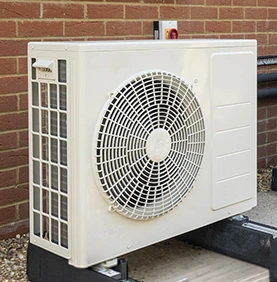
Air source heat pumps work by moving heat rather than generating it. During the winter, they extract heat from outside even when it’s cold outside. Here’s how!
- An outdoor condensing unit contains refrigerant, a liquid with an extremely low boiling point. Even very cold outdoor air makes this liquid boil and turn into a gas.
- The gas then travels into a compressor, which squeezes the gas, causing it to get very hot.
- The hot gas flows to coiled tubes in an indoor unit, where a fan blows air across the coils. This warmth is pushed into the house through vents (if you’re using a central ducted system) or the head (the wall-mounted part of a mini-split or ductless heat pump).
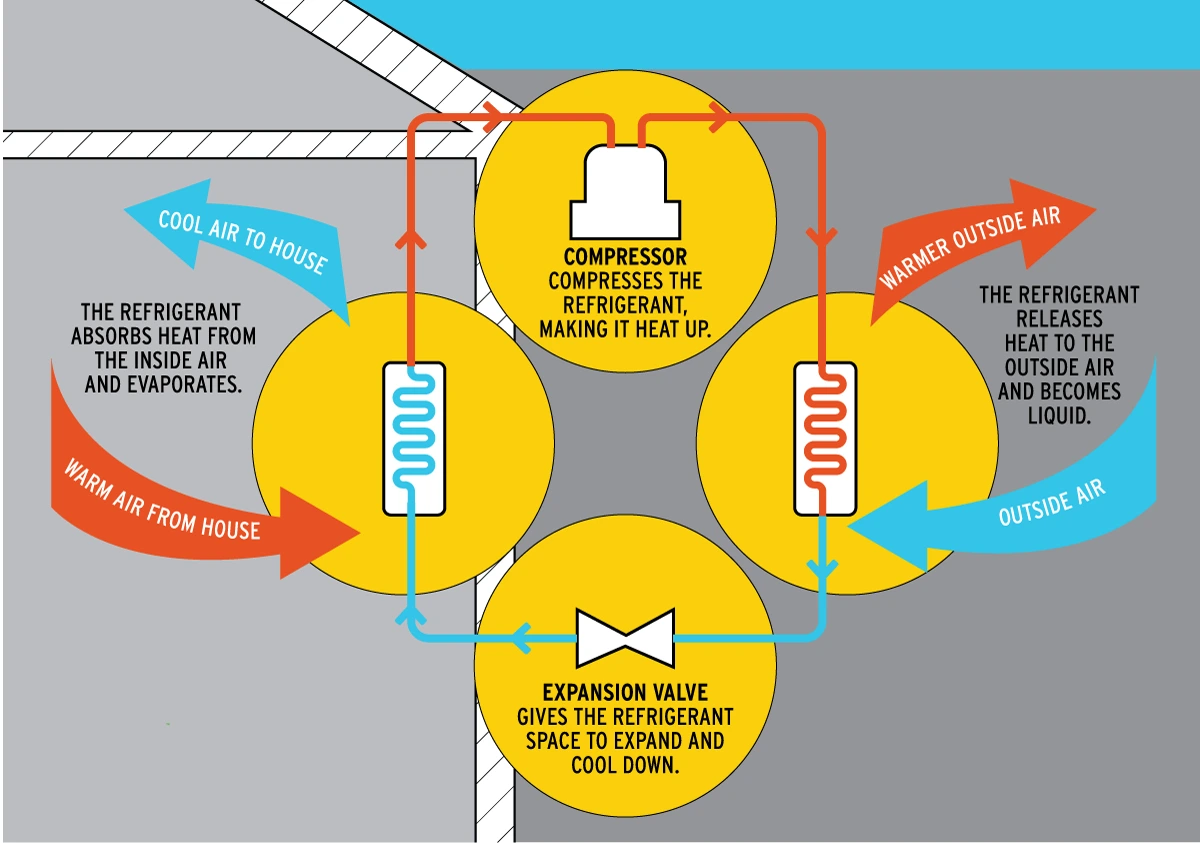
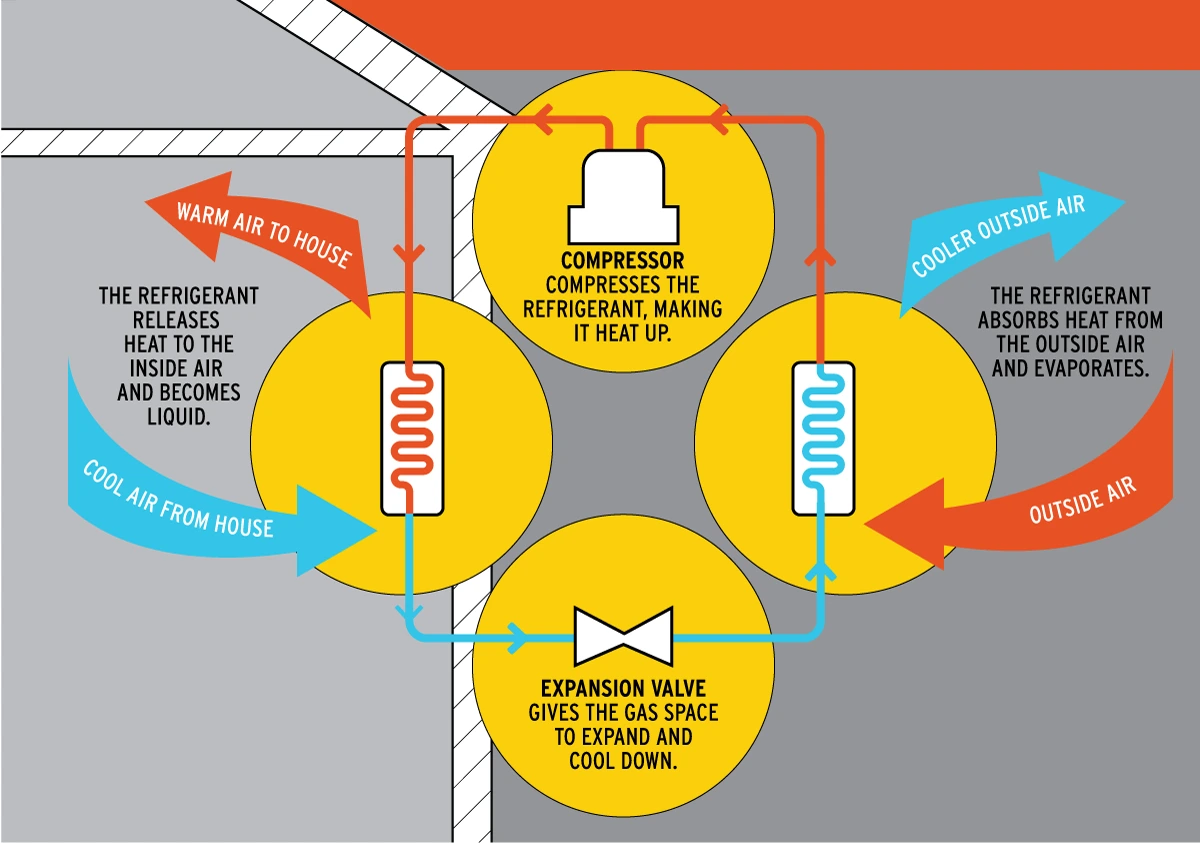
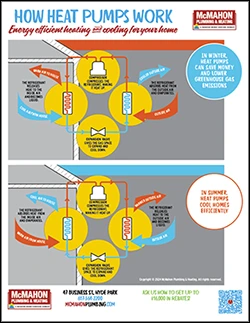
How a Heat Pump Works
A visual walk-through of the science behind heat pumps — and why they're so much more efficient than traditional systems.
Why heat pumps are so efficient, and how to think about the payoff
Coefficient of performance is a unit that measures how much heat a piece of equipment delivers for every unit of electricity it uses. Anything that generates heat by burning fuel or using resistance has a maximum COP of 1.
Air source heat pumps are much more efficient because (as noted above) they move heat, rather than generating it. Air source heat pumps today have COP’s between 3 and 4; the manufacturers publish this information on their product data sheets or submittals. A heat pump’s COP is based on a seasonal average; it will perform better in mild temperatures.
Translating energy efficiency into cost savings is more complicated because electricity, gas, and oil prices are always fluctuating. Generally, a heat pump will save money compared to other electric heaters (like baseboard heaters) and oil-fired equipment. It also cools your home more efficiently than older air conditioning systems.
| Heating system | Typical efficiency | What that means |
|---|---|---|
| Air source heat pump cold-climate | COP ~2.0–4.0 | Delivers 2–4 units of heat per unit of electricity — it moves heat instead of making it. Higher in mild weather, lower in deep cold. |
| Electric resistance baseboard, electric furnace | COP 1.0 (100%) | One unit of electricity in, one unit of heat out. No losses, but no bonus either. |
| Gas or propane boiler/furnace — condensing | 90–98% AFUE | A second heat exchanger pulls extra heat from the exhaust before it leaves, so very little escapes up the flue. |
| Gas or propane boiler/furnace — atmospheric non-condensing | 80–85% AFUE | Relies on natural draft; hot exhaust goes up the chimney, carrying usable heat with it. |
| Oil boiler/furnace | 80–90% AFUE | Generally non-condensing; some heat is always lost through the flue. |
Only the heat pump clears 100%, because it moves ambient heat rather than burning fuel. COP measures efficiency, not operating cost — what you pay is efficiency × your local fuel price.
Can I use a heat pump as my only source of heat during the winter in Massachusetts?
Heat pumps were first used in homes in the late 1940s, and HVAC manufacturers began pushing them for year-round home climate control as early as the 1950s. So it is literally true to say “This is not your grandfather’s heat pump.”
The single-speed compressors that were used in older systems had trouble keeping up with cold weather. Today’s heat pumps feature variable-speed compressors, more advanced refrigerants, and smart defrost cycles, keeping them performing well even at subzero temperatures. A properly designed and maintained heat pump system will have no trouble holding up through a cold New England winter.
Heat Pumps in Cold New England Winters
More on how heat pump technology has evolved to handle extreme cold weather
—C.S. (on Google reviews)
Can I get rebates for a heat pump?
Yes! Mass Save® offers various types of rebates for residents installing heat pumps. The rebates will depend upon:
- Are you replacing your whole heating system?Mass Save awards a larger rebate if you are actually getting rid of your existing heating system, regardless of whether it’s powered by oil, gas, or electricity. The idea is to replace less-efficient systems with more efficient systems. They will, however, award a lower Basic Heat Pump rebate based on the heating capacity of your system.
- Are you using it just to add air conditioning?A heat pump will cool your home more efficiently than an air conditioner, but rebates are only available in cases where the heat pump is displacing at least some of your home’s existing heating equipment.
The best and safest way to ensure that you get the maximum rebate or incentive payment for your heat pump system is to work with a member of the Mass Save Heat Pump Installer Network, such as McMahon. We meet specific credential and ongoing training requirements to ensure that your heat pump system will be installed safely and correctly and will actually save you energy.

Ask Us About A Rebate
Get any savings and rebates you are entitled to! When you get your heat pump installed by McMahon, we will make sure you know about any incentives and special offers that can help cover the installation cost. Your estimate is free in the Greater Boston area
Why Electrification
Buildings account for roughly one-third of Massachusetts’ greenhouse gas emissions. Gas and oil heating will always use fossil fuels, but more and more electricity is generated in the Commonwealth from renewable energy such as solar and wind power.
That’s why electrification is a key part of Massachusetts’ climate goals. Using renewable energy has a much lower carbon impact than using gas or oil. Incentive programs such as Mass Save® are designed to encourage energy conservation and electrification. Heat pumps meet both of these goals. Even if your electricity is generated from fossil fuels now, switching your heating system from gas or oil to electric puts you in a position to be heating with renewable energy as more and more renewables come onto the grid.
Learn more about electrification and Massachusetts’ climate goals by reading our FAQ.
Heat Pump FAQ for Massachusetts Residents
Answers to the questions Greater Boston homeowners ask most often about air source heat pumps.
In other words, a heat pump will lower your carbon emissions now, and it will lower your carbon emissions even more in the future.
Ducted or ductless?
There’s no single best air source heat pump system. The right one depends on the home you have, the heating system you currently use, your budget, and how you want your home to feel.
A few rough guidelines to keep in mind as you think it through:
- If you already have ductwork (such as for a central AC system and/or forced hot air), a ducted heat pump can replace both your AC and your furnace or boiler with a single year-round system.
- If you don’t have ductwork, or your ducts are in poor shape, a ductless mini split — single-zone or multi-zone — usually makes more sense than adding new ducts.
- If you have specific problem rooms or an addition that doesn’t get conditioned well, a mini split can solve that without touching the rest of your system.
The best way to figure out exactly what fits your home is to have a licensed installer take a look. A good estimate includes a real conversation about what you want from the system — not just a quote for whatever the contractor sells the most of.
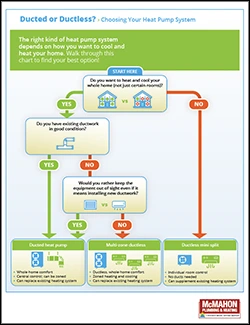
Ducted or Ductless?
A quick decision tree that walks through the key questions in a couple of minutes. Get a clear starting point — and know which questions to ask when you're getting an estimate.
Free resources and downloads
Explore these resources to learn more about air source heat pumps.

Ducted or Ductless? Choosing Your Heat Pump System
A quick decision tree to help you figure out the right kind of heat pump for your home.
How a Heat Pump Works
A visual walk-through of the science behind heat pumps — and why they're so much more efficient than traditional systems.
Heat Pump FAQ for Massachusetts Residents
Answers to the questions Greater Boston homeowners ask most often about air source heat pumps.
Henry the Heat Pump Coloring Pages
A little summer fun for the kids while you tackle your home cooling project. Print and color.
