 BOOK SERVICE
A summer problem worth solving
If you live in Greater Boston, you already know two things about summer: it gets hot enough to matter, and your electricity bill knows it. The state has some of the highest electricity rates in the country, and air conditioning is one of the biggest reasons summer bills jump. That puts homeowners in a tough spot — you want to be comfortable, but you want your air conditioning to be energy efficient.
The good news is that how you cool your home is largely within your control. From simple habits and maintenance to upgrading the equipment itself, there’s a wide range of ways to stay comfortable while using less energy. Some cost nothing., while some pay for themselves over time. All of them help you save money and keep your summer budget for summer fun where it belongs.
This guide starts with why cooling costs so much in the first place, then moves through practical ways to save energy, then into the upgrades worth considering when you’re ready for something better. By the end, you’ll have a clear picture of what’s possible for your home.
One System, Year Round Comfort
Switch to a heat pump! Save energy, lower your bills, and enjoy all-season comfort. Free estimates.
Why your electricity bills climb in the summer
Summer bills go up for a simple reason: air conditioning is one of the most energy-hungry things in your house. A central AC system or a window unit running through a New England heat wave can easily become the single largest line item on your electric bill for those months.
A few things stack on top of each other to make this worse:
Cooling runs longer than you think. On a 90-degree afternoon, your AC isn’t just running for an hour and shutting off. It’s working continuously to fight against heat coming in through windows, walls, and the roof. The longer it runs, the more energy it draws.
Your house generates its own heat. Air conditioning doesn’t just fight the weather — it also fights everything inside your home that gives off heat. TVs, computers, gaming consoles, printers, even older incandescent light bulbs all add warmth to the rooms they’re in. The more “hot stuff” you have running, the harder your cooling system has to work to keep up.
Older equipment uses more energy for the same result. An air conditioner installed fifteen years ago is doing the same job as a new one — keeping you cool — but using far more electricity to do it. Efficiency standards have improved significantly, and equipment also loses efficiency as it ages and components wear.
Humidity makes the problem worse. Air conditioners don’t just cool the air; they also remove moisture from it. Boston summers are muggy, and humid air takes more energy to condition than dry air. If your system is undersized or aging, it may struggle to keep up with the humidity, leaving your home feeling warmer than the thermostat reading.
You’re paying more per unit of electricity than most of the country. Even before you turn anything on, the cost of each kilowatt-hour in Massachusetts runs well above the national average. That means every hour of AC use costs you more here than it would somewhere with cheaper power — and it’s why efficiency matters so much here.
Most homeowners look at a high summer bill and assume there’s nothing to do but pay it. There’s actually quite a bit you can do.
—A.K. (on Google reviews)
What’s driving high electricity costs right now
If it feels like your electric bill has been climbing year after year, you’re not wrong. Massachusetts electricity rates have risen substantially over the past decade, and there’s no sign of them dropping back down.
A few things are pushing prices up:
Natural gas dependence. New England generates a large share of its electricity from natural gas, but the region’s pipeline capacity is limited. When natural gas demand spikes, as it does during winter cold snaps, the supply gets squeezed and wholesale electricity prices climb. Those costs eventually flow through to your bill.
Aging infrastructure. The electrical grid that delivers power to your home is decades old in many places, and utilities are spending billions to modernize transmission lines, replace equipment, and harden the system against storms. Those upgrades are necessary, but the costs are passed along to ratepayers through delivery charges.
Growing electricity demand. New data centers, increased electrification of heating and transportation, and overall economic growth are all pushing demand higher. More demand on the same constrained system means higher prices. When new generation facilities are built, these costs are also passed on to ratepayers.
The result is that Massachusetts homeowners pay among the highest electricity rates in the country. None of this is something an individual homeowner can fix. The result of all this? A less efficient cooling system costs you more today than it did five years ago, and it’ll cost you more next year than it does today. Investing in efficiency, whether through better habits, better maintenance, or better equipment, will help you save money today and save even more money in the years to come.
How to ease the strain (and your bill) without buying anything
Some of the most effective ways to cut your summer electricity use don’t involve new equipment at all. They’re habits and adjustments, and they add up faster than you’d expect, especially on the hottest days when your AC would otherwise be running flat out.
Pick a setpoint and stick to it. Constantly adjusting your thermostat down whenever the house feels warm uses more energy than picking a reasonable temperature and leaving it alone. Modern AC systems, including heat pumps, run most efficiently when they’re holding a steady temperature, not chasing big swings. Pick a comfortable summer setpoint, and let the system do its job. When you’re going to be out of the house for hours at a stretch, set the temperature for a few degrees warmer; you’ll use less energy than keeping an empty house cool, and a few minutes of recovery time when you get home is worth the savings.
Pre-cool in the morning. Outdoor temperatures peak in the late afternoon, which is exactly when your AC has to work hardest to keep up. If you cool your home earlier, the system runs while it’s cooler outside, which is more efficient. Then in the hot afternoon, it’s mostly maintaining rather than fighting.
Use fans to make a higher setpoint feel cooler. Ceiling and box fans don’t lower the room temperature, but the breeze across your skin can make you feel several degrees cooler. That means you can raise the thermostat a few degrees without feeling the difference, and your AC runs less. Just remember to turn fans off when you leave a room — they cool people, not empty spaces.
Block the sun before it gets in. A surprising amount of summer heat comes through windows, especially on the south and west sides of the house. Closing blinds or curtains on the sunny side during the day cuts the heat load your AC has to fight. Light-colored or blackout curtains help most, but even regular blinds make a real difference.
Open the windows at night. In New England, summer nights are usually cool. Take advantage of this! Open windows after sunset to flush the warm air out, then close everything up before the day heats up to trap the cool air inside. On milder nights, this can let you avoid using the AC at all.
Skip the oven on hot days. Ovens dump enormous amounts of heat into your house, which your AC then has to remove. Grilling outside, using a microwave or air fryer, or eating cold meals on the hottest days keeps the heat out of the kitchen — and out of the rest of your home.
Watch the “hot stuff” in your house. As we mentioned earlier, electronics and lights generate real heat. Turning off devices when you’re not using them, including TVs, computers, gaming consoles, and printers.
Do regular maintenance. A clogged filter forces your AC to work harder to push air through, which uses more electricity and cools less effectively. Checking and cleaning or replacing filters every one to three months is the single highest-impact maintenance task you can do yourself.
—C.S. (on Google reviews)
Make your existing equipment more efficient
Before you start thinking about replacing your cooling system, it’s worth making sure the one you have is working as well as it can. A neglected system uses more energy than it needs to, cools less effectively, and wears out faster. A well-maintained one can run efficiently for years.
What “maintenance” looks like depends on what you have. Here’s how to get the most out of each type of cooling equipment in your home.
Central air conditioning
Central AC is the workhorse of summer cooling in many Boston-area homes, and it’s also the system most likely to be costing you money through neglect. A few things make a real difference:
Change or clean the filter regularly. This is the single most impactful thing you can do. A dirty filter restricts airflow, which forces the system to work harder and longer to move conditioned air through your home. Check it every one to three months during cooling season, and replace or clean it as needed.
Keep the outdoor unit clear. The condenser unit outside needs unrestricted airflow to release heat. Clear away leaves, grass clippings, and debris. Trim back bushes and vegetation so there’s at least two feet of clearance on all sides. If the unit is shaded by a tree or under a deck, that’s fine, but anything physically blocking airflow is hurting your efficiency.
Have it professionally serviced annually. A licensed HVAC technician will check refrigerant levels, clean the coils inside and out, inspect electrical connections, and confirm the system is operating the way it should. Coils in particular accumulate dust and grime over time, and even a thin layer noticeably reduces the system’s ability to transfer heat. All this makes your system use more electricity to cool your home (not to mention the extra wear and tear).
Check the thermostat and ductwork. A miscalibrated thermostat makes the system run when it doesn’t need to. Leaky ducts let conditioned air escape into attics, basements, and crawl spaces before it reaches the rooms you’re trying to cool. If your home has rooms that never feel as cool as the rest, have a professional evaluate the system when they’re doing the annual service.
If your central AC is more than 15 years old and showing its age, no amount of maintenance will bring it back to modern efficiency standards. At that point, it’s a good idea to explore upgrade options later in this guide.
Heat pumps
If you already have a heat pump, you already have one of the most energy-efficient cooling systems available. Keeping it that way comes down to a few simple habits:
Keep the filters clean. Heat pump indoor units (the wall- or ceiling-mounted heads in ductless systems, or the air handler in ducted systems) have filters that need regular cleaning. For ductless heads, check them every one to three months — you can typically slide the filters out, vacuum them, rinse them with warm soapy water, and allow them dry completely before putting them back in. Clean filters mean better airflow, better efficiency, and longer equipment life.
Keep the outdoor unit clear. Same as with air conditioners: clear debris away from the unit, trim back vegetation. During the winter, make sure it’s not buried by snow or blocked by ice buildup. In summer specifically, watch for grass clippings and pollen which can clog the coils over time.
Schedule annual professional service. A professional technician will check refrigerant levels, inspect electrical connections, clean internal components, and confirm that the system is performing as it should. For a system that runs year-round (cooling in summer, heating in winter), this annual checkup is especially important. Catching small issues with your heat pump early will prevent bigger problems down the road.
Window and through-wall air conditioners
Window and through-wall units are the most common cooling solution in older Greater Boston homes, especially in apartments, triple-deckers, condos, and houses without central air. They’re convenient and inexpensive compared to a whole-home system, but they’re also the least efficient way to cool a home — and there’s a meaningful gap between a well-maintained unit and one that’s barely limping along.
Make sure it’s sized right for the room. An oversized unit cools the room too quickly and shuts off before it can remove humidity, leaving the space cold and clammy. An undersized unit runs constantly without ever quite catching up. If you’ve always felt like your AC was struggling — or freezing you out — sizing may be the reason. Through-wall units in particular are easy to inherit at the wrong size, since the previous owner picked them and you’re stuck with the sleeve.
Seal the gaps around the unit. For window units, air leaking in around the sides is air your AC has to cool all over again. Weatherstripping, foam panels, or seasonal insulation kits make a noticeable difference, especially on units installed in older windows that don’t quite close around the frame. For through-wall units, the seal between the unit and its wall sleeve matters just as much — gaps and worn gasketing let conditioned air out and outside air in. Worth checking and re-sealing every few years.
Clean the filter monthly.The filter is usually a small slide-out screen in the front of the unit. It clogs quickly with dust and pet hair, and a clogged filter chokes the airflow. A monthly rinse during cooling season keeps the unit working the way it should.
Vacuum the coils once a season. With the unit unplugged, vacuum the front grille and the visible coils to remove dust buildup. Dirty coils dramatically reduce the unit’s ability to move heat out of the room.
Handle winter the right way. A window unit left in place all winter is essentially a hole in your wall, leaking heated air out and cold air in. Take window units out in the off-season, or at minimum cover them with an insulated cover. Through-wall units can’t be removed, but they can — and should — be covered. An insulated exterior cover over the sleeve, plus a fitted interior cover indoors, makes a real difference in how much heat your home loses through that wall in winter.
If you’re running two, three, or more window or through-wall units across your home every summer — wrestling with humidity, watching your bills climb, and dealing with the noise and the bulk — that’s the situation an upgrade was designed for. We’ll come back to it.
Fans
Fans aren’t a cooling system, but they’re the cheapest and most effective tool for stretching the cooling system you already have.
Use ceiling fans to raise your thermostat setpoint. A ceiling fan creates enough air movement to make a room feel three to four degrees cooler than the actual temperature. That means you can set the thermostat higher and use less AC without sacrificing comfort. Set ceiling fans to spin counterclockwise in summer (looking up) to push air downward.
Turn fans off when you leave the room. Fans cool people, not rooms. A ceiling fan running in an empty room is just spending electricity to spin. The same goes for box fans and tower fans.
Use exhaust fans to vent heat and humidity. Bathroom and kitchen exhaust fans pull hot, humid air directly out of the house. Run the bathroom fan during and after hot showers, and use the range hood whenever you cook. It’s a small habit that keeps the muggiest air from settling into the rest of your home.
Try a window fan at night. Greater Boston summer nights usually cool off. A box fan in a window — pulling cool air in on one side of the house and pushing warm air out on the other — can flush the heat out overnight and reduce how long your AC has to run the next day.
When air conditioner maintenance isn’t enough
Good maintenance habits will get you a long way — often years of comfortable, reasonably efficient cooling without replacing anything. But there’s a point where the math changes. If your central AC is over fifteen years old, you keep needing to add more window units, or your bills keep climbing no matter what you try, the most effective thing you can do is upgrade to a more efficient system.
Upgrade options: cooling your home more efficiently
If your existing cooling system is past its prime, or if you’re tired of fighting summer with a patchwork of window units, an upgrade is worth thinking about seriously. Today’s cooling systems are dramatically more efficient than what was being installed even ten years ago — and in Greater Boston, where electricity is expensive and getting more so, that efficiency translates into real savings every month.
There are two main directions to consider. Each one fits a different kind of home and a different set of priorities.
A more efficient central air conditioner
If you already have ductwork in your home and you’re happy with how central cooling feels, replacing an aging central AC with a modern, high-efficiency unit is a straightforward upgrade. You keep the delivery system you have, swap out the equipment, and start using less electricity for the same comfort.
A few things to know:
Look for ENERGY STAR certification. ENERGY STAR–certified central AC units meet strict efficiency standards set by the EPA and use noticeably less energy than standard models. It’s the easiest shorthand for “this is a genuinely efficient unit,” and it’s a precondition for most utility rebates.
Pay attention to SEER2 ratings. SEER2 (Seasonal Energy Efficiency Ratio 2) measures how efficiently a system cools over an entire season. Higher numbers mean better efficiency. Modern systems range from around 14 SEER2 at the entry level up to 20+ SEER2 for premium models. Stepping up from an older 10-SEER system to a modern 16+ SEER2 unit can cut your cooling energy use significantly.
Get the sizing right. An oversized central AC short-cycles — it cools the air quickly but doesn’t run long enough to remove humidity, so your home feels cold and clammy. An undersized one runs constantly without keeping up. A proper installation includes a load calculation (sometimes called a Manual J) that sizes the system to your home’s specific needs. This matters more than the brand you choose.
Don’t forget the ducts. If your existing ductwork is leaky, poorly insulated, or undersized, putting a new high-efficiency unit on top of it will leave a lot of your investment in the attic. Have the ducts inspected as part of the upgrade conversation.
A modern central AC system is a good fit if you already have ducts in good shape, you want a familiar setup with a single thermostat, and you primarily need cooling. If you’re considering replacing your heating system at the same time — or you don’t have ducts to begin with — the next option deserves a serious look.
Heat pumps
A heat pump is the most versatile and energy-efficient cooling option available today, and for many Greater Boston homes, it’s the most compelling upgrade path. Despite the name, a heat pump is also an air conditioner — a single system that cools your home in summer and heats it in winter, using only electricity.
The reason heat pumps are so efficient comes down to how they work. A traditional furnace or boiler generates heat by burning fuel. An air conditioner removes heat from your home. A heat pump moves heat — from outside to inside in winter, and from inside to outside in summer. Moving heat takes far less energy than generating it, which is why heat pumps can deliver several times more heating or cooling per unit of electricity than older systems.
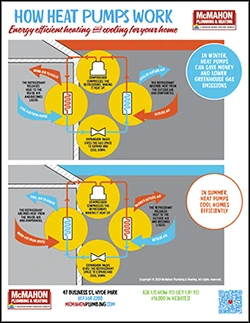
How a Heat Pump Works
A visual walk-through of how heat pumps move heat in summer and winter — and why it's so much more efficient than traditional heating and cooling.
A few reasons heat pumps make particular sense in Greater Boston:
One system, year-round. Instead of paying to maintain a separate furnace or boiler and an air conditioner, you have a single system handling both. That’s one annual service appointment, one set of components to maintain, and one footprint outside your home.
They work in our climate. Older heat pumps struggled in deep winter cold, which gave them a reputation that’s now decades out of date. Modern cold-climate heat pumps are engineered specifically for places like New England and perform well even in single-digit temperatures. They’ve been installed in tens of thousands of Massachusetts homes at this point — they’re not experimental anymore.
They cool quietly and evenly. Heat pumps tend to run at variable speeds, which means they ramp up and down smoothly rather than the loud on-off cycling of a traditional AC. Most homeowners notice the quieter operation and the more even temperatures right away.
They can qualify for rebates and incentives. Mass Save offers rebates for qualifying heat pump installations, with the largest rebates available when a heat pump replaces fossil-fuel heating like oil or propane. The rules and amounts change over time, so it’s worth asking what currently applies to your situation when you’re getting an estimate.
Ducted vs. ductless: two ways to deliver heat pump comfort
Once you’ve decided a heat pump is the right direction, the next question is how the conditioned air gets to your rooms. There are two main approaches, and the right one depends mostly on your home.
Ducted heat pumps work the way a traditional central system does. A single outdoor unit connects to an indoor air handler, which pushes conditioned air through ductwork to vents in each room. If your home already has ducts in good condition, this is often the most straightforward upgrade — you keep the familiar delivery method, but with dramatically more efficient equipment behind it. Everything stays hidden: no wall units, no visible indoor components, just vents you already have.
If your ducts are old, leaky, or undersized, they may need work as part of the upgrade — or you may be better off skipping ductwork entirely and going ductless. A good installer will assess this honestly.
Ductless mini splits skip ductwork entirely. A single outdoor unit connects via refrigerant lines to one or more indoor “heads” — slim units mounted on a wall or ceiling. Each head has its own thermostat and runs independently of the others, so different rooms can be set to different temperatures.
Ductless systems shine in a few specific situations: homes without existing ductwork, additions or finished basements that ductwork can’t easily reach, and rooms that have always been hot or cold no matter what the rest of the house is doing. They install with minimal disruption — no tearing into walls or ceilings to run ducts — and a single project can be sized to handle one problem room, a few rooms, or an entire house.
For whole-home coverage without ducts, multi-zone ductless systems connect several indoor heads to a single outdoor unit, giving you room-by-room temperature control across the whole house. It’s the most flexible option, and increasingly the default recommendation for older Greater Boston homes that don’t have ductwork — many of which would be expensive or impractical to retrofit.
Choosing the right upgrade for your home
There’s no single best cooling system. The right one depends on the home you have, the heating system you currently use, your budget, and how you want your home to feel.
A few rough guidelines to keep in mind as you think it through:
- If you have good ductwork and only need cooling, a high-efficiency central AC is the simplest, most familiar upgrade.
- If you have good ductwork and want to replace your heating too, a ducted heat pump replaces both your AC and your furnace or boiler with a single year-round system.
- If you don’t have ductwork, or your ducts are in poor shape, a ductless mini split — single-zone or multi-zone — usually makes more sense than adding new ducts.
- If you have specific problem rooms or an addition that doesn’t get conditioned well, a ductless mini split can solve that without touching the rest of your system.
The best way to figure out exactly what fits your home is to have a licensed installer take a look. A good estimate includes a real conversation about what you want from the system — not just a quote for whatever the contractor sells the most of.
How to decide what kind of energy-efficient air conditioning is right for your home
There’s no substitute for having someone who knows what they’re doing actually look at your home. Square footage, insulation, existing ductwork, how you use your rooms, what your summer bills look like — all of it matters.
A few questions worth thinking about:
How much of your home do you actually need to cool? Some homeowners want every room comfortable all summer. Others mostly need the bedrooms cool at night and the main living areas cool during the day. The scope of what you’re trying to achieve has a big effect on what makes sense.
How’s your existing equipment holding up? If your central AC is past fifteen years old, your window units are multiplying, or you’re hauling things in and out of windows every spring — those are signs it’s worth upgrading sooner rather than later.
Are you thinking about your heating system too? If your furnace or boiler is also showing its age, a heat pump can handle both cooling and heating with one system, which changes the math. If your heating is newer and you’re happy with it, a cooling-only upgrade is the simpler path.
How McMahon can help
McMahon Plumbing & Heating has been keeping Greater Boston homes comfortable since 1952. We install the leading brands of energy-efficient cooling systems, including Fujitsu, Mitsubishi, and Daikin. We’ve earned Fujitsu’s Elite Plus distinction for our heat pump work — which means faster installations, expert service, and the backing of a name homeowners can trust.
Every free estimate starts with a real conversation about your home and what you’re trying to achieve. No high pressure, just a straight assessment and a recommendation that fits.
One System, Year Round Comfort
Switch to a heat pump! Save energy, lower your bills, and enjoy all-season comfort. Free estimates.
Free resources and downloads
Save these for later, or share them with someone who might find them useful.
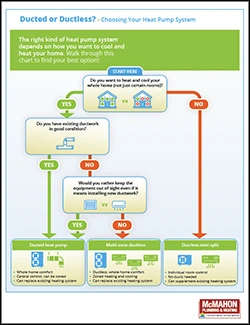
Ducted or Ductless? Choosing Your Heat Pump System
A quick decision tree to help you figure out the right kind of heat pump for your home.
How a Heat Pump Works
A visual walk-through of the science behind heat pumps — and why they're so much more efficient than traditional systems.
Heat Pump FAQ for Massachusetts Residents
Answers to the questions Greater Boston homeowners ask most often about air source heat pumps.
10 Ways to Cool Down This Summer (No AC Required)
Practical tips to keep your home cooler — and your summer electric bill lower — without buying anything new.
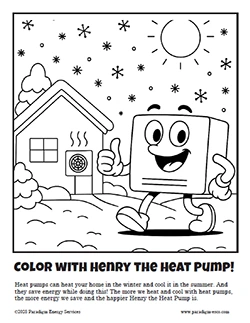
Henry the Heat Pump Coloring Pages
A little summer fun for the kids while you tackle your home cooling project. Print and color.