
 BOOK SERVICE
How a Heat Pump Works
A heat pump is one of the most efficient ways to heat and cool a home, but the way it does that can feel a little counterintuitive. The short version: a heat pump doesn’t create heat or cold the way a furnace or air conditioner does. It moves heat from one place to another — and that’s the trick that makes it so efficient.
Here’s what’s actually happening inside.
The basic idea
All heat pumps work the same way. A refrigerant (a special fluid that easily changes between liquid and gas) circulates through a closed loop of pipes that runs between an outdoor unit and an indoor unit. As the refrigerant moves through that loop, it absorbs heat in one place and releases it in another. By controlling where it absorbs and where it releases, the system can either heat or cool your home using the same equipment.
One System, Year Round Comfort
Switch to a heat pump! Save energy, lower your bills, and enjoy all-season comfort. Free estimates.
In summer, the refrigerant pulls heat out of your home and dumps it outside. In winter, the cycle runs in reverse: the refrigerant pulls heat from the outside air (yes, even when it’s cold outside — there’s still heat in the air) and brings it inside.
In summer: cooling your home
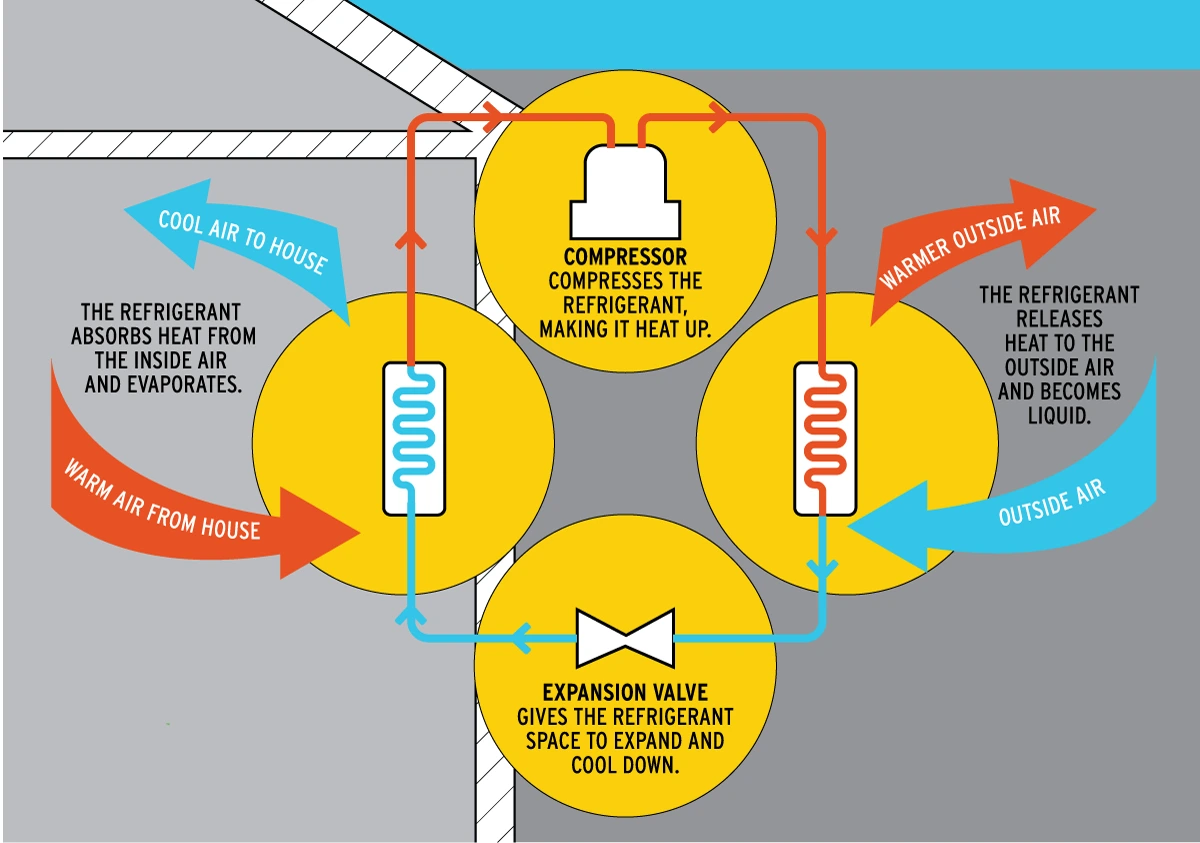
When your heat pump is cooling, here’s the sequence:
- The refrigerant absorbs heat from the air inside your home and evaporates from a liquid into a gas. This is what cools the air being blown into your rooms.
- The compressor compresses that gas, which makes it heat up significantly.
- The hot refrigerant releases its heat to the outside air and condenses back into a liquid.
- The expansion valve gives the refrigerant space to expand and cool down, ready to absorb more heat from inside the house and start the cycle again.
The net effect: heat from inside your home ends up outside, and cool air ends up in your rooms. This is essentially the same process as a traditional air conditioner — heat pumps are extremely efficient air conditioners that happen to also work in reverse.
In winter: heating your home
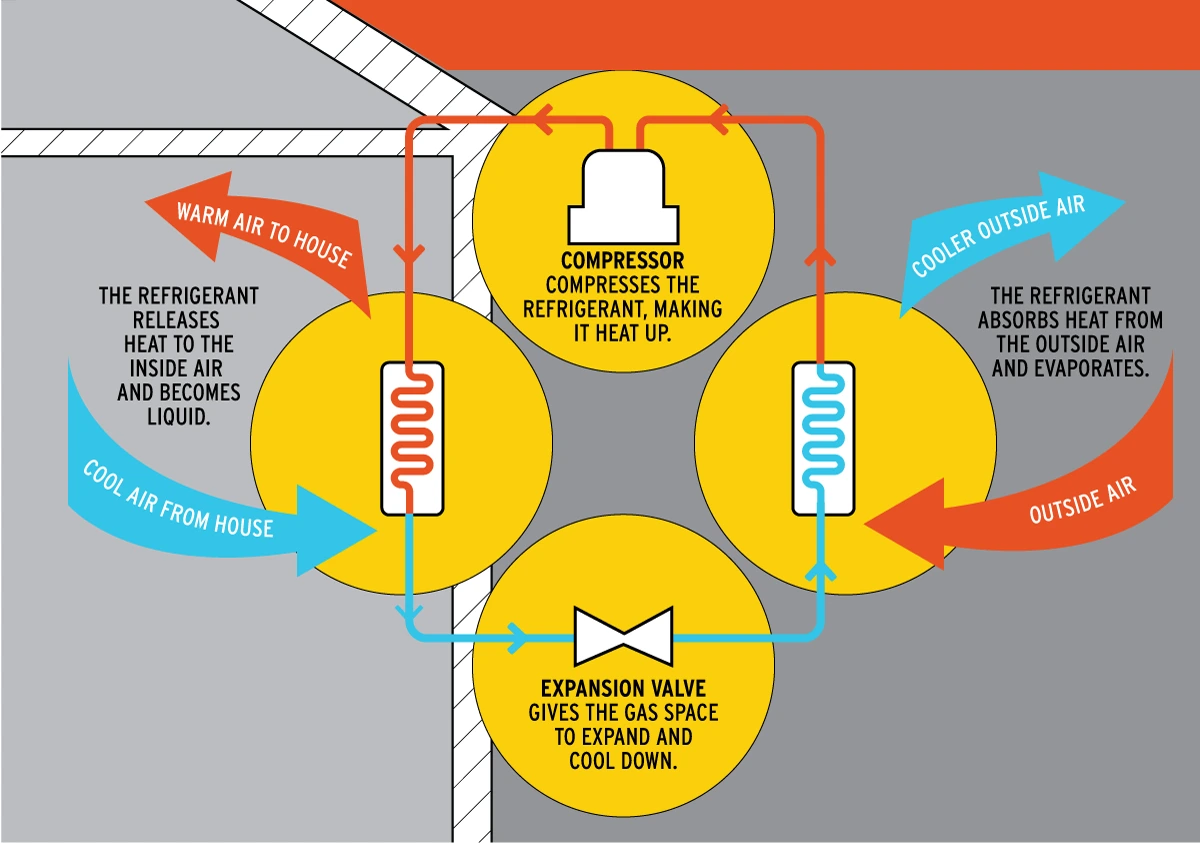
When the weather turns cold, the system reverses. The same equipment, the same refrigerant, just running the other direction:
- The refrigerant absorbs heat from the outside air and evaporates. Even cold outdoor air contains heat — it’s just relative — and modern cold-climate heat pumps can pull useful heat out of the air at temperatures well below freezing.
- The compressor compresses the gas, raising its temperature even further.
- The hot refrigerant releases its heat into the air inside your home, warming your rooms, and condenses back into a liquid.
- The expansion valve resets the refrigerant for another trip outside to absorb more heat.
Because the heat pump is moving heat rather than creating it, it can deliver several times more heating energy than the electrical energy it uses. That’s why heat pumps can dramatically cut heating costs compared to oil, propane, or electric resistance heating.
Why this matters
The efficiency of moving heat versus generating it is the whole reason heat pumps have become the default recommendation for new heating and cooling systems in places like Massachusetts. One system, year-round comfort, dramatically lower energy use than older alternatives — all using a process that’s been refined for decades.
>If you’re thinking about a heat pump for your Greater Boston home, McMahon Plumbing & Heating installs ducted and ductless systems from the leading manufacturers, including Fujitsu, Mitsubishi, and Daikin. We’ve earned Fujitsu’s Elite Plus distinction for our heat pump work — which means faster installations and the backing of a trusted name in comfort.
One System, Year Round Comfort
Switch to a heat pump! Save energy, lower your bills, and enjoy all-season comfort. Free estimates.